
A Note from Malcolm Robinson
A few days ago I received an email from a complete stranger but whose story fascinated me. You see, he was a fellow member of that rare and exclusive club
‘Out Of Hospital Cardiac Arrest Survivors’.
The other thing was that how many similarities there were to my own story
Here’s what he sent:
Hi Malcolm. I have just this minute found your documentary “Surviving Cardiac Arrest – The Chain of Survival” and I am absolutely blown away by it. Like you, I survived an Out Of Hospital Sudden Cardiac Arrest thanks to someone providing CPR and in circumstances startlingly similar to yours. Mine happened in December 2022.
I wouldn’t be surprised if you’ve heard people say before how reassuring it is to hear about someone who has lived through an experience like ours. But it was seeing for the first time what the medical teams did that was an absolute revelation for me. Your documentary helped fill some gaps in my nightmare scenario that I have absolutely no memory of and I wanted you to know how very grateful I am.
I’m going to continue to watch and read anything else you publish and who knows, I may even turn up at one of your training sessions.
Just one more thing Malcolm; an off-duty Cardiology Nurse gave me CPR. She was the second person on the scene. I’m now wondering if they’re miraculously stationed anywhere where a cardiac arrest might occur?!
Best wishes for your continued success.
Andy Dickinson
And here , with Andy’s permission, is that story…
My Story – By Andy Dickinson
My story begins on Sunday 1st January 2023 when I woke up in hospital. A nurse was saying to me “Hello Andrew. You’re in hospital”.
That was the first I knew about it. But strangely enough I wasn’t shocked, I wasn’t surprised, I wasn’t even curious to know why. I was very much drugged up and I’m pretty sure whatever it was they were giving me made me feel very pleasant indeed. I’ve tried to get hold of some since but apparently its controlled.
Behind the nurse was our daughter Amber. She was saying “Hello” to me in her adopted Essex accent. But that didn’t happen, she wasn’t there, the drugs were also giving me hallucinations – of a very pleasant nature, luckily for me. I believe they’re just as likely to be horrendous nightmares but mine were nice and trippy.
What had happened that led to me waking up in hospital was I’d had a Cardiac Arrest. A “Sudden Cardiac Arrest” that happened “Out Of Hospital”. All distinguishing terms used by clinicians to describe an OOH SCA.
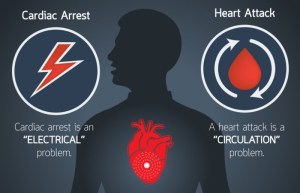
A cardiac arrest, in layman’s terms, happens when the heart suddenly stops pumping. It’s an electrical fault. In the heart there’s plumbing and electrics. A tiny electrical impulse stimulates your heart to make it beat and pump blood around your arteries – the plumbing. If the plumbing blocks you get a heart attack. You’ll likely experience pain but you’ll remain conscious. But if the electrics go your heart stops. You suddenly lose consciousness. Blood stops pumping to the brain and every other vital organ. You stop breathing. You need immediate medical intervention. And that’s what had happened to me.
On Friday Dec 30th 2022 Amber and I set off on a run. It should have been about an hour, around 6 miles/10 kilometres around the highways and byways of Harlow, Essex. My wife Margaret and I were visiting for Grandson Harvey’s birthday and obviously the new year.
Amber and I ran together whenever we could and it was always a lovely, relaxing Dad and Daughter event. Apparently at about half way I said I wasn’t feeling too good. Just generally unwell with a tightness in my chest. I say “apparently” because I don’t actually remember anything after tying up my running shoes before we set off. A nurse said to me a few days later what a wonderful thing the human body is, protecting us from our worse nightmares by erasing the memories. And I was very, very grateful for it.
When I’d said I didn’t feel good we walked a bit, then tried running a bit, then walked a bit more until eventually I needed to stop and rest and try to recover. We were in a quiet suburban back road with a bit of a dilemma; we didn’t have a phone with us. We’re runners, we travel light. So the conversation apparently went along these lines – Amber would run home and get the car, come back and pick me up to take me home.
Lesson #1; ALWAYS carry a phone.
Amber got home in a very impressive 11 minutes. She had it recorded on her running watch (although she subsequently deleted it). She took another 2 or 3 minutes to get back to where she left me. When she got out of her car she couldn’t find me at first. She had to look around until she spotted me at the bottom of somebody’s driveway laying prone and she said she knew straight away I wouldn’t be breathing. She started CPR, she started shouting, screaming at the top of her voice for some assistance and she called 999.
She struggled to hear what the operator at the Ambulance control was telling her because she couldn’t hold the phone AND do CPR on her Dad. Also, I was emitting strange breathing noises, not breathing normally but what we now know was “agonal breathing” or “hypoxia”.
Her cries for help were heard first by a kid on a scooter who came up to her and asked what he could do. She told him to find a street sign, she didn’t know the name of the road she was on to tell the Ambulance control. He came back with the name of the road and she fed that back to Ambulance control. (Ed.- an example of why we now encourage everyone on our courses to put the free app, what3words, on their phones)
Another kid, this one inside the house at the top of the drive, heard her cries. He went and woke his Mum, Sunitha, a Cardiac Nurse. My lucky breaks that day will forever be a source of wonder to me. You just never know when a cardiac nurse might be nearby right when you need one.
Amber trained as a Lifeguard when she was about 16 yrs old which would have included CPR training. She’s now 33 yrs old. I haven’t asked her if that’s the extent of her training, she also worked in hospitals for a few years, but how she was able to apply the steps of CPR training under such pressure is another source of wonderment (and immense pride, naturally).
The First Responder Paramedic, Mark, arrived within about 4 minutes. He was nearby when he received the call. I’m not sure exactly what the order of thing was but Amber would have been doing CPR for at least 10 minutes. When Mark arrived Amber said he took charge and organised things. He put a pad on my chest that indicates if CPR is being done properly; hard enough/fast enough. We marvelled at this bit of technology.
She also said Sunitha was the toughest at CPR. She broke the most ribs!! I’ll say a bit more about who helped with chest compressions in a minute but Sunitha, sweet, slightly built, little Sunitha did best apparently.
Mark also asked for some blankets from the house to keep me warm. Amber said how cold I felt. There was also a lot of blood. I must have collapsed flat on my face because I had grazes all down the right side of my face.
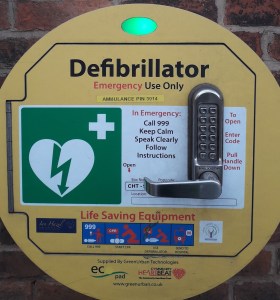
Over the course of the next 30 minutes or so they gave me five shocks with the defibrillator before my heart restarted. But a bit more went on before that.
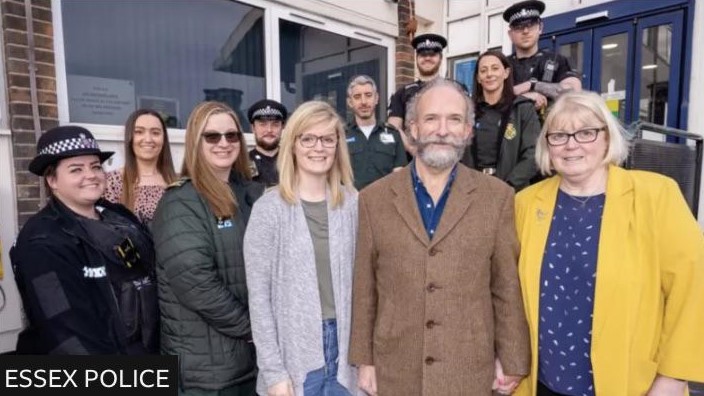
Two Police cars arrived. PC’s Matt and Rhys and Special Constable Lauren. When they got the call they thought they’d just arrive and direct traffic, keep the roads clear, that kind of thing. But no, they took their turn at CPR too.
Two Ambulances arrived. Paramedics Jo and Sarah were quite nearby and on their way back from other calls.
A Helicopter Air Ambulance arrived. On the helicopter were Dr Jamie and a Paramedic. The nearest they could land was about a half mile away so they had to run carrying their bags full of medical equipment and drugs with more Police Officers stopping traffic on the busy A1025 to get them across quickly. I’ve seen those bags and Amber tried lifting one. They are HEAVY!!
Dr Jamie got me stable enough to travel by ambulance to Basildon Hospital. As a Doctor he made some crucial decisions; he administered drugs to start my heart as well as deciding which hospital to send me to and to use the ambulance, not the helicopter. A total of eight clinicians were working on me in the back of the ambulance before it left the scene. My wife Margaret had arrived at the scene at some point and obviously got to see the traumatic and delicate situation I was in. I can’t imagine the trauma they suffered.
When it came time to travel Margaret opted to NOT go in the ambulance because it would have meant one less clinician in there with me. A good call because I needed more shocks on the 30 minute journey to Basildon.
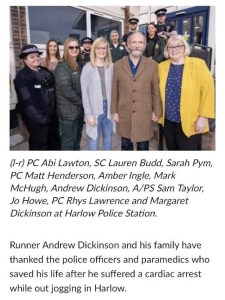
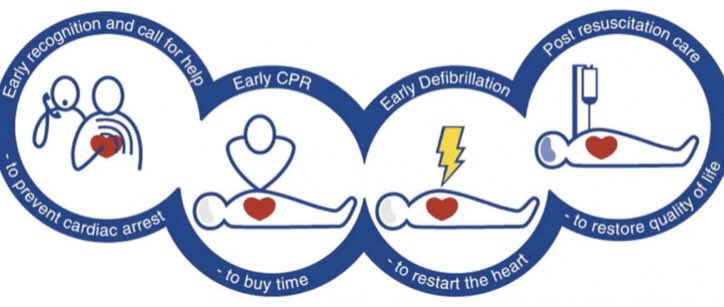
At this point it is clear Amber’s CPR actions saved my life. If CPR isn’t started within 2 or 3 minutes permanent brain damage is likely. Another 2 or 3 minutes and I’d be dead. 90% of OOH Sudden Cardiac Arrests in the UK don’t survive. We don’t know for certain how long I’d been down before Amber found me, but it must have been seconds.
Matt and Rhys, the Police Officers, gave me such a surprise when we met a few weeks later. They told me that when they got back to their car and sat down they cried. The stress, physical exertion and overwhelming emotions kicked in. Meanwhile the ambulance took me to Basildon Hospital Cardiothoracic Centre (CTC) where they found a 100% blocked ‘Left Anterior Descending’ (LAD) Artery. It was stented. Apologies to anyone who had to wait for a stent but that’s the way to jump the queue.
I was put in an induced coma for a couple of days, stayed in hospital a further nine days and I was discharged on 9th January 2023. The broken ribs and sternum were really the only source of pain, particularly when I sneezed!
Rehabilitation
By Wednesday 11th January we were back home in Yorkshire. I’m fortunate enough to have the greatest of support networks and I don’t just mean medical professionals: My wife, who saw me in the middle of a load of Ambulances and Paramedics working on me, still managed a calm, loving bedside manner when I woke up.
Our daughter Amber, who was responsible for keeping me alive in the first place, continued to be concerned and proactive in those early days.
Our Son Ross who was 200 miles away when he received the news must have had a nightmare journey to get to my hospital bedside.
Rehabilitation for family can easily be overlooked. The Essex & Herts Air Ambulance Trust (EHAAT) have brilliant services available for anyone who wants it. Amber got a copy of the timeline, which includes decisions made, drugs administered, treatment and actions right up until I arrived at Basildon Hospital. EHAAT will also provide psychological therapy, again for anyone wants it. I haven’t made use of any of their services, I don’t currently feel the need, but it’s a comfort knowing its there.
On Thursday 12th January 2022 our GP arranged to see me at the Surgery, the day after I arrived home, phenomenal care and service that has continued ever since. They set up my repeat prescription. I was on a standard combination of:
beta blocker (bisoprolol)
ACE inhibitor (ramipril) (prevents blood vessel narrowing)
anti platelet (aspirin and ticagrelor) and
proton pump inhibitor (lansoprazole)
heart failure med (dapagliflozin)
blood pressure (eplerenone and furosemide)
statin
+ GTN Spray
One year on and;
Beta blockers stopped in June and Furosemide (blood pressure)
Statins reduced 50% (to 40mg) in September
Anti platelet (Ticagrelor) and Lansaprazole stopped in December
The remainder I’ll be on for life.
The prescription thing and all the medication was quite a biggy for me. There was some heart impairment from the heart attack and what I’ve come to know as ‘Brain Fog’; inability to process information as quickly, difficulty making decisions, short term memory issues. So dealing with all the information that came at me and medication schedules was difficult. Thankfully Margaret was there with me to help.
There is also a significant amount of information available out there when you need it. Information on-line and in pamphlets has been invaluable. I had no idea what is a Cardiac Arrest prior to this and I read a great article about Brain Fog on the ‘Chain of Survival’ FB group. Also, there’s…
Sudden Cardiac Arrest UK (now a Reg’d Charity),
I had just one Stent, no Pacemaker, no ICD (built in defibrillator), no restrictions on driving (other than broken ribs that needed to mend). I had an assessment for Cardio Rehabilitation at Pinderfields Hospital, Wakefield, on 16th February, just a month after my discharge from Basildon Hospital and started on 12 rehab sessions the next day. I graduated on 29th March. Cardio Rehab were also at pains to point out services available to family, acknowledging the importance of their needs as well as the patient.
Apart from the exercises we all did Cardio Rehab got me running again on the treadmill. I was concerned about advice to ‘build up slowly’ and ‘listen to your body’ so using the treadmill under supervision was invaluable to me. After a couple of sessions using the treadmill I began ‘Couch-to-5k’ (3 miles), an NHS 9-week programme to get you running again. I followed it diligently, making sure I didn’t overdo it.
I was basically starting again with my running. I didn’t realise at first but I lost about 1½ stones in hospital and most of it seems to be muscle. So I needed to build up my strength again. Before the cardiac arrest my running stats for the year 2022 show me averaging 30 miles every week. 3 months later I was doing Couch-to-5k. That was difficult to come to terms with.
On Saturday 13th May 2023 I ran my first Park Run (5k / 3 miles). A couple of months later; 2nd July I ran the Ware 10k (6 miles) and raised £1k for EHAAT in the process. My next milestone was 10 miles on 5th November and I’m right back to where I was pre heart attack. Fatigue has an affect though and there are now more days in between runs.
I had entered the 2024 London Marathon, I thought it would be a wonderful story for the Air Ambulance charity, but my wife thought differently and talked me out of it. You need to consider your family and their mental health. In my case they’re the ones who witnessed the trauma and have that to live with. I also have to realise an OOH SCA changed my life forever. Things will never be the same again. And its not all bad either; I have a much more relaxed attitude to life. Little things that were important before are now relatively unimportant (i.e. work) – I’d retired from the 9 to 5, but now I’m back doing TV/Film Extra Work, but only when I want to. And I have a bunch of pills to take each day and that’s not so bad either. The cost of holiday insurance is astronomical though and that is quite bad!
Resources
A little research and a lot of advice:
NHS leaflets
Sudden Cardiac Arrest FB Group
Cardiac Buddies
MY Cardiac Buddies (“MY” stands for “Mid Yorkshire” NHS Trust).
Dicky Tickers (‘Near You’ search)
1 in 10 Survivor (book)
“A Starseed Odysey” (book/fiction)
As I progressed I shifted from one FB group/information source to another, on what I consider a progressive scale and my heart “re-modelled” as the clinicians call it; from “Severely Impaired” on discharge from hospital to “Mildly Impaired” after an ECG in June. I’ve addressed “brain fog” by doing crosswords, going back to work, writing down my story and delivering “My Story” by way of a presentation to the group “MY Cardiac Buddies”.
Postscript from Malcolm Robinson
Andy came across my documentary by chance on the Sudden Cardiac Arrest UK website where it was recently reviewed by Paul Swindell. You can see that review here
 CPR Counts